

The World At Your Doorstep: The Logistics of the World Cup
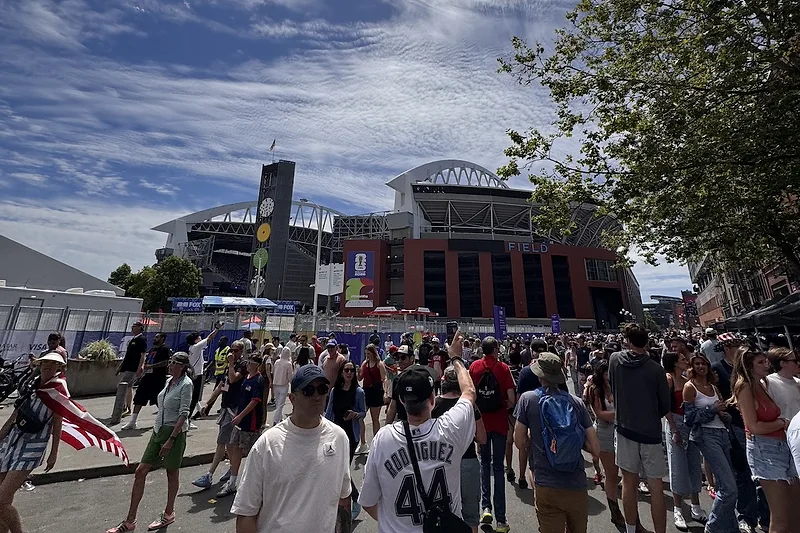
As millions of fans from dozens of countries have flooded into North America for the World Cup, it’s become easy to get caught up in the fervor of the largest sporting event in the world. What’s easily overlooked, though, is the years of logistical preparation that go into ensuring that cities are prepared, stadiums are properly outfitted, and merchandise is well-stocked.
“It’s often underestimated when the world comes to your doorstep,” says Nigel Hughes, a city tech expert with infrastructure asset management company Brightly Software.
Prior to the World Cup, FIFA estimated that the tournament would bring in at least five million fans combined across the United States, Canada and Mexico, along with around $40 billion in revenue, and 800,000 jobs. And with 104 matches spread across 16 host cities in three countries, the sheer scale of the event means that every individual host has to account for how that surge will affect things like utilities, waste, electricity, transportation and public safety.
In Foxborough, Massachusetts, the city spent $70 million to renovate its historic seven-acre City Hall Plaza to host FIFA’s 16-day World Cup Fan Festival. That included new lighting, the construction of a new entrance hall at the north entrance, and the installation of a massive outdoor screen. In the Pacific Northwest, Washington state spent $120 million to fund transportation and capital improvements in the Seattle area, to cover increased security staffing on public transit, community outreach efforts, and dozens of watch parties.
That’s just the tip of the iceberg too. With the World Cup now in full swing, cities are still adjusting in real time to ensure that public services in host cities that can often be taken for granted aren’t strained to breaking point by the sudden influx of fans. Even something as simple as waste disposal is a consideration, Hughes notes.
“If you’ve suddenly got a load of Airbnbs being occupied, what do you do about refuse collection when they’re dumping out a weekend’s worth of waste in a day?” he posits. “It’s an enormous challenge.”
The Logistics of People
Infrastructure isn’t all that cities have to account for. When hundreds of thousands of fans descend on a city for weeks at a time, they have to figure out how to move people around without bringing transportation networks to a grinding halt. That’s where bus companies like First Student come in, as FIFA’s official transportation sponsor for nearly all of the World Cup’s host cities.
“Whether it’s the host committees, transportation event management and law enforcement, all these folks have really done a good job in creating a partnership in every city that we’ve been in,” says First Student Brandon Dudley.
In the New York-New Jersey area alone, First Student has been moving roughly 20,000 people each day for the World Cup, spread across 160 buses running three loops to get supporter groups to and from the stadium for match days. All of that is the result of meticulous planning beforehand, spanning numerous dry runs, as well as coordinating with host committees on the best routes, and working with supporters directly to suss out logistics.
That process was especially crucial when Boston played host to Scotland’s Tartan Army supporter group, which famously drank the city dry, and was enthusiastically embraced by locals.
“They have an official supporter group that actually is shockingly way more organized than any group that I’ve been a part of,” Dudley recounts. “They really did a good job organizing their group and guiding our operation to be able to figure out what days we can help them and how many people they have, and we even guided them on some things to do in Boston.”
Over the course of the Tartan Army’s time in Boston, that meant figuring out transportation to see the Red Sox at Fenway Park, as well as a massive fan gathering at Boston Commons, and days-long pub crawls across the city.
Stocking the Shelves
Behind every jersey, scarf and souvenir sold during the World Cup is a supply chain years in the making. Long before the first match of the tournament kicks off, companies like Adidas and Nike are coordinating with manufacturers and logistics partners to plan out the flow of custom-made World Cup apparel from their Southeast Asian factories to host countries across the ocean. Over the course of that process, inventory teams are working to determine allocations for each host city, the volumes that will need to be transported, and the modes of transport that will be used.
The fact that three countries were tagged to host the 2026 World Cup also presented a unique set of challenges that retailers had never had to account for in past tournaments, which have traditionally taken place in a single country.
“Having multiple locations makes it very complicated,” says Serkan Selcuk, logistics and supply chain management consultant at Middlebank Consulting Group. “Every jersey, cap and piece of event merchandise represents thousands of planning decisions made across continents. Success depends on synchronizing suppliers, carriers, warehouses, retailers and event organizers into one coordinated supply chain.”
On top of that, retailers have to deal with different customs processes in each of the three host countries, all while determining which ports merchandise will be shipped into, finding space in nearby warehouses, and competing with existing capacity demand across a variety of other industries. Apparel companies also have to account for the fact that there will be more demand for apparel from World Cup semifinalists and finalists, without knowing who those teams will be ahead of time.
“That’s where brands put all of their power in their planning,” Selcuk explains. In the weeks leading up to the World Cup final, retailers are already moving inventory between locations based on which teams are advancing through the tournament. By that last match, the goal is to have the right mix of jerseys, scarves and other fan gear as close to the stadium as possible, so retailers can capitalize on a surge in demand that may only last for a matter of days.
The World At Your Doorstep
While fans experience the World Cup over the course of a month, cities spend years preparing for those few weeks. But what really makes an event like the World Cup such a remarkable logistical undertaking is that, when everything goes according to plan, millions of fans never notice the incredible amount of work that made it possible.
“The event itself is just at the end of a long process of planning,” says Hughes.
